
Why Do I Feel Like I Am Not Good Enough? 7 Powerful Insights

Why Do I Feel Like I Am Not Good Enough?
Short answer: You may feel like you are not good enough when your sense of self-worth becomes closely tied to achievement, approval, appearance, relationships, or comparison with other people. Perfectionism, repeated criticism, difficult experiences, and harsh self-talk can add to that feeling. But feeling inadequate is not proof that you are inadequate. Sometimes the problem is less about what you can do and more about how you have learned to judge yourself.
If perfectionism makes every setback feel personal, read our guide to understanding feelings of failure.
The thought can surface after a small mistake or a major setback. You do not get a job, so your mind says, “I’m incapable.” A relationship ends, and the conclusion becomes, “Nobody will want me.” The event is real; the sweeping judgment about your worth is an interpretation.
If that sounds familiar, this article explains why the feeling develops, why it can become persistent, and how to respond without giving up on the things that matter to you.
If you need a starting point today: Notice what triggered the thought, separate what happened from what you are assuming it means, and choose one small action you can realistically take. You do not have to solve your whole life in one afternoon.
What Does “I’m Not Good Enough” Actually Mean?
“I’m not good enough” is rarely a precise statement about a single skill. It often turns a particular disappointment into a judgment about your entire identity.
Consider the difference:
- Event: “I didn’t get the job.” Judgment: “I’m not capable.”
- Event: “My relationship ended.” Judgment: “I’m unlovable.”
- Event: “I made a mistake.” Judgment: “I’m a failure.”
- Event: “My friend reached a milestone before me.” Judgment: “I’m falling behind in life.”
The first statement in each pair describes something that happened. The second assumes that one experience reveals who you are as a person. It leaves little room for context, learning, bad luck, or the many parts of life that a single outcome cannot measure.
Self-esteem refers to how positively you evaluate the qualities that make up your self-concept, according to the American Psychological Association’s Dictionary of Psychology. Your self-esteem can fluctuate; your abilities, circumstances, and relationships also change. None of those fluctuations provides a complete measure of your worth.
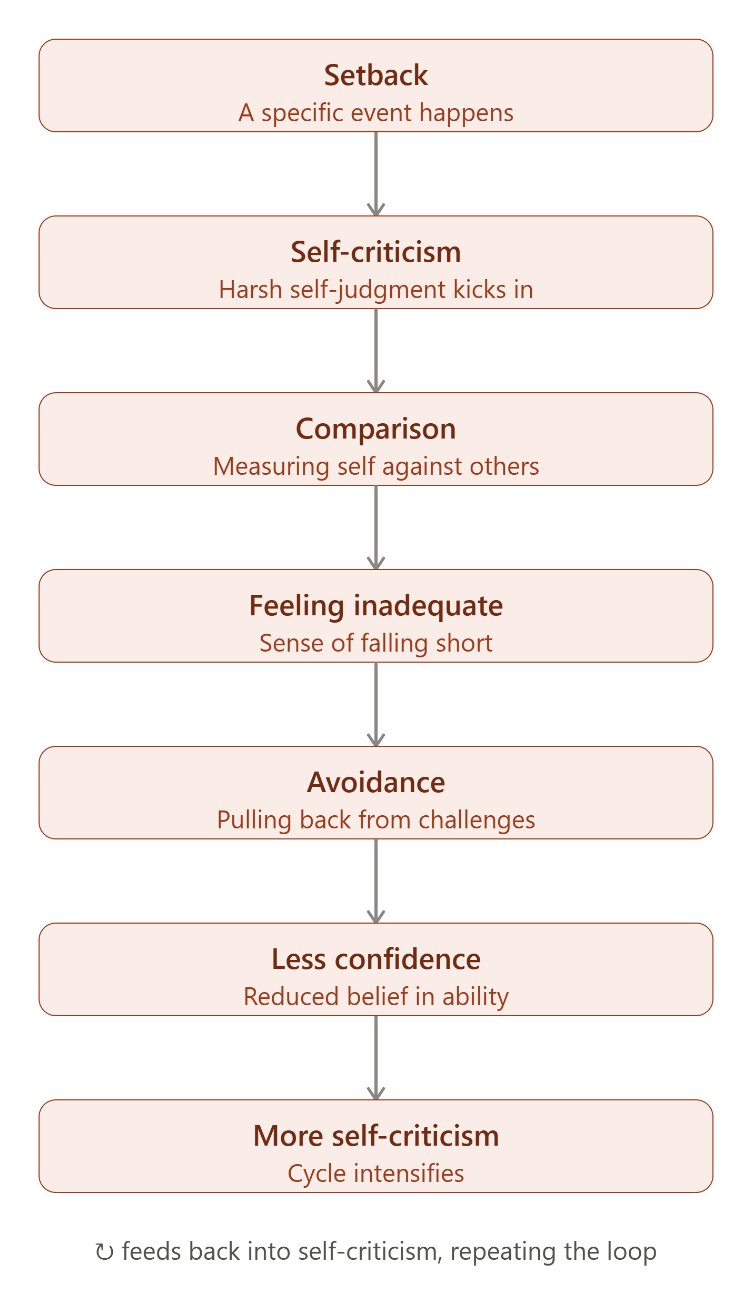
7 Reasons You May Feel Like You’re Not Good Enough
There is no single explanation that fits everyone. These common patterns can overlap, and the reasons may be different at work, in relationships, or in your private thoughts.
1. Your self-worth depends heavily on achievement
You may have learned to treat success as evidence that you deserve respect and failure as evidence that you do not. A promotion feels reassuring for a while, but the next difficult project brings the doubt back. The standard keeps moving.
Psychologists call this idea contingent self-worth: self-esteem that depends strongly on meeting standards in particular areas of life. Research discussed by the American Psychological Association found that, among college students, placing self-worth on external sources such as appearance, approval, and academic performance was associated with more stress and other difficulties. Those findings do not mean ambition is harmful. They suggest that relying on achievement as your only source of self-respect can be costly.
Try making room for two separate truths: “I want to improve my performance” and “My worth does not need to rise and fall with every result.”
2. You’re comparing your real life with an incomplete picture of someone else’s
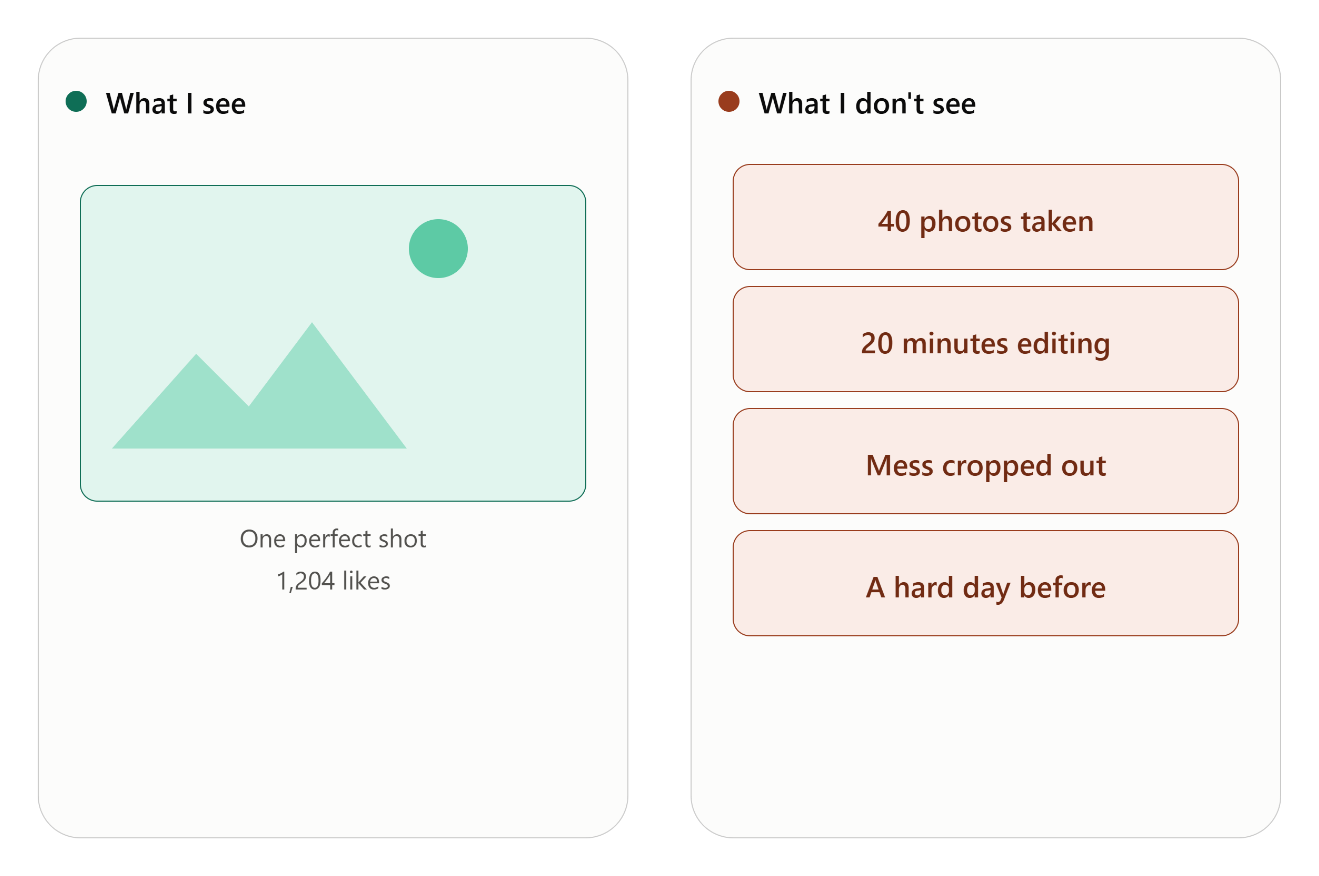
Comparison is a normal human habit. But you usually know far more about your own struggles than you do about another person’s. You may see their promotion without seeing their uncertainty, or their polished social-media post without seeing the attempts that did not make it online.
If comparing your progress with others has left you uncertain about your own direction, explore our guide to feeling lost in life and finding your way forward.
In four studies involving 798 participants, Midgley and colleagues (2021) examined social comparisons across online and other settings. More frequent or extreme upward comparisons on social media were linked with immediate declines in self-evaluation, and people with lower self-esteem appeared particularly vulnerable in these studies.
Instead of asking, “Why am I not where they are?” ask, “What parts of their circumstances can I actually see, and which parts am I filling in?”
3. Perfectionism makes ordinary mistakes feel unacceptable
Having high standards is not necessarily a problem. The more painful pattern emerges when your self-esteem depends on never making mistakes, disappointing others, or falling short of a demanding ideal.
A 2024 systematic review and meta-analysis covering 83 studies and 32,304 participants found a moderate negative association between perfectionistic concerns and self-esteem (pooled correlation, r = -0.42). Perfectionistic concerns involve worries about mistakes and negative evaluation. For perfectionistic strivings, which are more closely related to setting high standards, the pooled association was negligible and slightly positive (r = 0.06). This distinction matters: striving to do well is not the same as feeling worthless when you cannot do something perfectly.
Perfectionistic thinking might sound like “If I can’t do it flawlessly, I shouldn’t try,” or “I should be further ahead by now.” It can turn growth into a moving finish line.
There is room for change. A 2022 review of randomized trials found that cognitive behavioral therapy approaches aimed at perfectionism improved several perfectionism-related measures, although individual results vary.
4. Harsh self-talk has become your default response
It is useful to recognize a mistake. It is less useful to turn that mistake into a personal attack. Compare “This didn’t work; what can I learn?” with “I’m useless; I ruin everything.” The first identifies a problem. The second makes a permanent claim about who you are.
The APA Dictionary notes that self-criticism can sometimes support growth, while persistent, harsh self-criticism is considered by some researchers to be a possible risk factor for depression. If your inner voice regularly speaks in absolutes, it is worth questioning whether its judgment is accurate, not just whether it feels convincing.
For another practical perspective, explore how to stop negative thinking patterns and separate recurring assumptions from what you actually know.
5. Earlier experiences shaped how you see yourself
Messages from parents, teachers, peers, partners, and media can influence self-esteem over time. The NHS guidance on low self-esteem also identifies difficult life events, unmet expectations, negative thinking, and unrealistic standards as possible contributors.
For example, imagine a child who often hears, “Why can’t you be more like your sibling?” As an adult, that person might automatically interpret a disappointing result as proof of being inferior. This is an illustrative example, not a claim about any particular person’s history.
You do not need a dramatic childhood experience to develop self-doubt, and you do not have to blame one person to understand a pattern. Recognizing an old message can simply help you decide whether it deserves to shape how you treat yourself now.
If these patterns have affected your confidence, read our guide to understanding why you’ve lost confidence in yourself.
6. You’re experiencing shame, not just disappointment
Disappointment says, “Something I wanted didn’t happen.” Shame can turn that into “Something is wrong with me.”
If you fail an exam, disappointment might lead you to change your study plan. If you decide the failure proves you are stupid, you may start avoiding exams or new challenges altogether. That avoidance then makes it harder to collect experiences that could challenge the belief.
If avoiding challenges has left you feeling unable to move forward, explore our guide to understanding why you feel stuck in life.
The aim is not to deny responsibility. It is to evaluate your choices without reducing your identity to the worst moment of your week.
7. Your relationships are affecting your sense of worth
Repeated rejection, criticism, disrespect, or comparisons within relationships can influence how you see yourself. Equally, supportive relationships can make it easier to develop a more balanced self-view.
A meta-analysis summarized by the APA reviewed 52 longitudinal studies involving more than 47,000 people. It found evidence of a reciprocal relationship: social relationships and self-esteem can influence each other’s development over time.
That does not mean you need everyone to like you. It means the quality of your environment matters. A healthy relationship allows disagreement without making someone’s basic dignity conditional on pleasing the other person.
Why Does the Feeling Keep Coming Back?
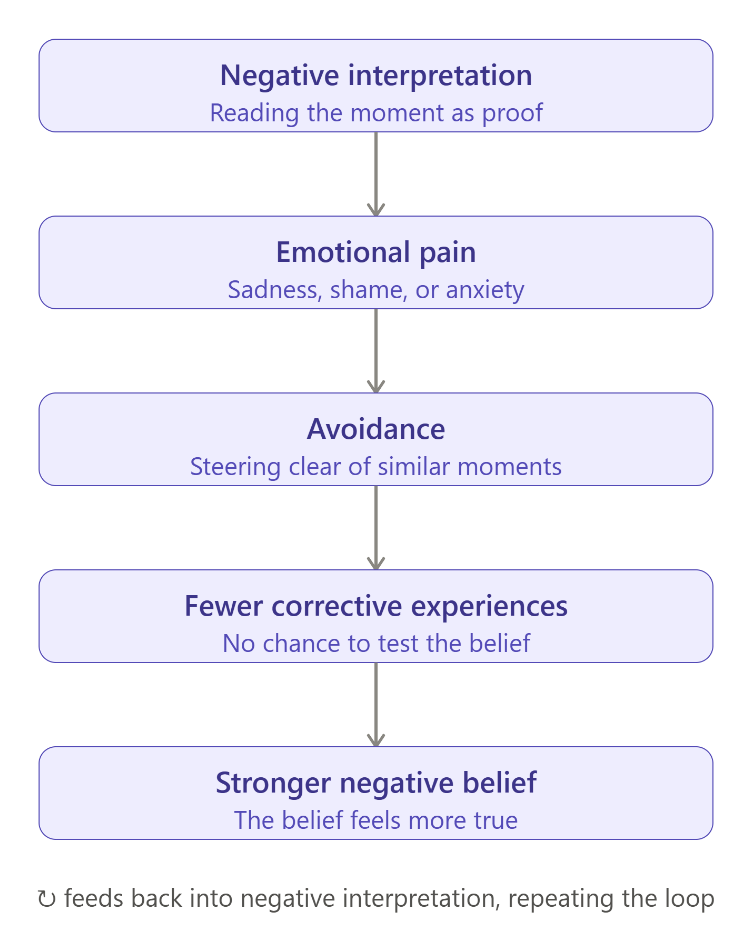
One reason the thought can persist is that it changes what you do next. A familiar cycle is:
Trigger → negative interpretation → painful emotion → avoidance → fewer corrective experiences → stronger negative belief.
Suppose you are passed over for a promotion. You interpret it as “I’m not capable,” feel ashamed, and stop putting yourself forward. In the short term, withdrawing may feel safer. Over time, you miss chances to learn, get feedback, or discover that the original conclusion was too broad.
The NHS describes how avoiding difficult situations can ease discomfort temporarily while reinforcing underlying doubts in the longer term. This cycle is one possible explanation, not a diagnosis.
Signs You May Be Struggling With Low Self-Esteem
Everyone doubts themselves sometimes. It becomes more important to pay attention when the pattern is persistent or begins to interfere with daily life.
You may notice that you:
- replay mistakes more often than successes;
- dismiss compliments or assume people do not mean them;
- compare yourself with people whose circumstances you barely know;
- seek constant reassurance but rarely feel reassured;
- find it hard to say no or set boundaries;
- avoid opportunities because you expect to fail;
- feel that accomplishments never count for long;
- apologize excessively or feel undeserving of kindness;
- treat criticism as proof that you are fundamentally flawed.
These are patterns to notice, not a checklist for diagnosing yourself. Some may also occur for reasons unrelated to self-esteem.
“I’m not good enough” versus “I need to improve”
| “I’m not good enough” | “I need to improve” |
|---|---|
| Turns one result into a judgment about identity | Describes a skill, habit, or situation |
| “I’m a failure.” | “That attempt didn’t work.” |
| Treats mistakes as threats to worth | Treats mistakes as information |
| Often encourages withdrawal | Leaves space for practice and support |
| Measures life against other people | Allows goals based on your own values |
The goal is not to convince yourself that you are perfect. It is to be more accurate and more constructive about what you can change.
How to Stop Feeling Like You’re Not Good Enough: 8 Practical Steps
You may not be able to switch off the feeling immediately. The following strategies are ways to respond to it differently and, with practice, make it less controlling. Several reflect the thought-challenging and behavioral approaches described in the NHS self-esteem guidance and its CBT-based self-help guide.
1. Separate the facts from the story your mind is telling
Write down the thought that appeared after a setback. Then divide it into what you know and what you are interpreting.
Thought: “I’m not good enough to get this job.”
Fact: “I was not selected for this position.”
Interpretation: “That proves I’m incapable.”
More balanced possibility: “There may be several reasons I was not selected. I can ask for feedback or work on a specific skill without judging my entire worth.”
You are not required to think positively. You are asking whether your conclusion is supported by the available evidence.
2. Ask yourself, “Good enough for what?”
The phrase “not good enough” becomes less convincing when you make it specific. Good enough for which position, relationship, skill, goal, or expectation? Whose standard are you using? Is it reasonable for your current circumstances?
Being inexperienced at a skill is not the same as being inadequate as a person. A useful next question is, “What would progress in this one area actually look like?”
3. Challenge all-or-nothing language
Notice words such as always, never, everyone, nobody, and completely. They can turn an isolated experience into an absolute rule.
Instead of “I always mess everything up,” try “I made a mistake in this situation; what happened?” Instead of “Everyone is ahead of me,” try “Some people are ahead of me in areas I care about, but I don’t know the full picture of their lives.”
A more accurate thought may not feel comforting at first. It can still be more useful.
4. Change the standard without abandoning the goal
You can stay ambitious while making the rules for success more realistic. If you are changing careers, “I must know everything before I start” may keep you frozen. “I need enough knowledge to take the next reasonable step” makes action possible.
Ask whether your current standard encourages learning or merely protects you from the possibility of making mistakes.
5. Practice self-compassion without excusing harmful behavior
Self-compassion means responding to difficulty with fairness rather than cruelty. It does not require claiming that every choice you make is right. As the APA explains, the concept commonly involves self-kindness, recognizing that imperfection is part of human experience, and noticing difficult feelings without exaggerating or suppressing them.
Try asking, “What would I say to someone I care about in exactly this situation?” Then offer yourself the same balanced response.
Research has associated self-compassion with well-being. A 2023 research synthesis found that self-esteem and self-compassion are related but not identical concepts. Separately, a 2021 systematic review suggested that compassion-focused interventions may help improve self-esteem. Its authors reported substantial variation between studies, so the findings should not be read as a promise of results for everyone.
6. Keep a realistic record of what you have handled
When you feel inadequate, failures may seem more memorable than the things you manage each day. Try collecting specific evidence: skills learned, responsibilities handled, helpful feedback, difficult conversations completed, or problems solved.
This is not an exercise in claiming you are exceptional. It is a way to avoid treating your mistakes as complete evidence and your strengths as irrelevant.
7. Stop using someone else’s timeline as your deadline
There is no single schedule for finding a career direction, building a relationship, developing confidence, or changing your circumstances. Someone else’s milestone can be meaningful to them without becoming a verdict on you.
Consider asking, “What matters to me at this stage of my life, with the resources and responsibilities I actually have?” That question makes room for personal priorities rather than endless comparison.
8. Take one manageable action instead of waiting to feel confident
If your thoughts are keeping you from trying, choose a step small enough to be realistic. Submit one application. Spend 20 minutes practicing a skill. Ask one question. Set one respectful boundary.
Confidence does not always appear before action. Sometimes, acting gives you new information about what you can do. If the step feels overwhelming, make it smaller or ask someone you trust for help.
A Simple Five-Step Exercise for the “Not Good Enough” Thought
This short exercise adapts a common cognitive behavioral approach: identifying a situation, noticing an automatic thought, and considering a more balanced response. You can write it in a notebook or save it on your phone.
If you prefer a guided format, Rihzen’s Journal Prompts for Overthinking offers questions to help you examine repeated thoughts. It is a self-reflection resource, not therapy or diagnosis.
- Trigger: What happened just before the feeling started?
- Automatic thought: What did your mind say about you?
- Facts: What do you know for certain, and what are you assuming?
- Balanced thought: What interpretation is fair, specific, and supported by the evidence?
- Next step: What is one useful thing you can do now?
Worked example: Comparing your progress with other people’s
1. Trigger: You see a colleague announce a promotion while you are still working toward a similar goal.
2. Automatic thought: “I’m falling behind. Maybe I’m just not good enough.”
3. Facts: Your colleague was promoted. You have not reached that milestone yet. You do not know every factor behind either person’s situation, and a different timeline does not establish your overall ability or worth.
4. Balanced thought: “I’m disappointed that I’m not where I want to be. My next step is to understand what skills or opportunities might help me progress, not to treat one comparison as a verdict.”
5. Next step: Write down one specific skill to develop and schedule 20 minutes to work on it this week.
Try it for yourself: My next step is: ______________________________.
What If Nothing I Do Ever Feels Like Enough?
If every accomplishment provides relief for only a short time, consider whether achievement has become the main way you try to earn your sense of worth.
The pattern may sound like this: “Once I get promoted, I’ll finally feel good enough.” The promotion comes, and soon the next standard appears. Or you reach a personal goal and immediately focus on the one you have not met.
There is nothing wrong with wanting to grow. The question is whether the goal is helping you build a life you value or becoming an endless test you can never quite pass.
A more sustainable stance is: “I can want to become better at something without treating myself as less deserving of respect today.”
To reflect on how your needs, values, and self-expectations fit together, you can try Rihzen’s Inner Mirror. It is an educational self-reflection tool, not a validated psychological assessment.
Can Feeling Like You’re Not Good Enough Be a Sign of Depression?
Sometimes, but the feeling alone does not mean you have depression. Feeling inadequate can arise during stress, rejection, major life changes, or periods of low self-esteem without establishing any specific mental health diagnosis.
Feelings of worthlessness or excessive guilt can also occur with depression. The National Institute of Mental Health identifies other possible symptoms, including persistent low mood, loss of interest, changes in sleep or appetite, low energy, difficulty concentrating, and thoughts of death or suicide. In major depression, symptoms typically occur over at least two weeks and affect day-to-day functioning, although a clinician considers the full clinical picture.
Consider speaking with a health professional if the feeling is persistent, severe, getting worse, or occurring alongside other symptoms. You do not have to wait two weeks if you are struggling significantly or worried about your safety.
When Should You Talk to a Therapist or Other Professional?
Professional support may be useful if self-criticism is hard to control, fear of failure keeps you from important opportunities, or your mood, sleep, relationships, work, or everyday responsibilities are being affected.
A qualified mental health professional can help you understand the beliefs and behaviors that keep the pattern going. Talking therapies, including cognitive behavioral therapy (CBT), are among the approaches described in NHS guidance for low self-esteem. You can also begin with a primary-care clinician if you are unsure where to start. The NIMH guidance on when to seek help provides another starting point for understanding the impact of symptoms on daily life.
Getting support is not an admission that you have failed to cope. It is an option when the problem is taking up more of your life than you want it to.
If You’re Thinking About Hurting Yourself
If feelings of inadequacy are accompanied by thoughts of suicide or urges to harm yourself, seek immediate support rather than trying to manage the crisis alone.
- In the United States: Call or text 988, or visit 988lifeline.org. Call 911 for an immediate life-threatening emergency.
- Outside the United States: Contact your local emergency service or use Find A Helpline to locate a crisis or emotional-support service in your country.
If you are in immediate danger, contact emergency services now. If you can do so safely, reach out to a trusted person and tell them you need support. The World Health Organization advises seeking support when someone may be at risk of suicide.
You Don’t Have to Prove Your Worth With Every Result
You may have skills to strengthen, mistakes to correct, and goals you have not reached. Those are real parts of life. They are not, by themselves, evidence that you are fundamentally inadequate.
When the thought “I’m not good enough” returns, ask something narrower and more useful: What exactly am I struggling with? What do I know? What standard am I using? What could I learn? What is one step I can take next?
You do not need to abandon ambition to be kinder to yourself. You can take responsibility, improve, and pursue the life you want without making self-criticism the price of admission.
Frequently Asked Questions
Why do I always feel like I’m not good enough?
Persistent self-doubt may be connected with low self-esteem, perfectionistic concerns, harsh self-criticism, comparison, difficult experiences, or making external approval a condition of self-worth. There is no universal explanation, and a particular feeling does not establish a diagnosis.
Why do I feel inadequate even when I succeed?
If achievement is your main way of measuring your value, success may provide only temporary relief. Once the next goal appears, the same doubts can return. It may help to evaluate progress while also developing sources of self-respect that do not depend on constant results.
Why do I compare myself to everyone else?
People naturally use others as points of reference. The comparison can become unhelpful when it focuses on people who seem further ahead or relies on carefully selected online highlights. Try noticing what information you do not have and returning to goals based on your own values.
Is perfectionism linked to low self-esteem?
It can be, particularly when someone is preoccupied with mistakes, criticism, and not meeting expectations. A 2024 meta-analysis found a moderate negative association between perfectionistic concerns and self-esteem, but it did not find the same pattern for simply striving for high standards.
Can self-esteem improve?
Yes. Your self-evaluation is not fixed. Identifying negative beliefs, considering more accurate interpretations, reducing avoidance, building supportive relationships, and working with a therapist when appropriate may help over time.
Does feeling worthless mean I have depression?
Not necessarily. Feelings of worthlessness can have several causes. But if they are severe, persistent, or accompanied by changes in mood, sleep, energy, interest, or daily functioning, consider seeking professional advice.
How do I stop feeling not good enough in a relationship?
Start by separating what another person has actually said or done from the conclusion you have drawn about your worth. Communicate your needs, notice repeated patterns of criticism or disrespect, and consider whether the relationship allows mutual respect and reasonable boundaries. Support from a counselor can help if the pattern is difficult to untangle.
What should I do when the thought hits suddenly?
Pause long enough to name the trigger. Write down the thought, identify one fact that supports it and one fact it overlooks, then choose a small next step. If the thought feels overwhelming or unsafe, seek support from a trusted person or professional instead of trying to handle it alone.
Sources and Further Reading
- American Psychological Association. Dictionary of Psychology: Self-esteem.
- American Psychological Association. Dictionary of Psychology: Contingencies of self-worth.
- Dittmann, M. (2002). Self-esteem that’s based on external sources has mental health consequences. APA Monitor on Psychology.
- National Health Service (NHS). Raising low self-esteem.
- Midgley, C., Thai, S., Lockwood, P., Kovacheff, C., & Page-Gould, E. (2021). When every day is a high school reunion: Social media comparisons and self-esteem. Journal of Personality and Social Psychology, 121(2), 285–307.
- Khossousi, V., et al. (2024). The relationship between perfectionism and self-esteem in adults: A systematic review and meta-analysis. Behavioural and Cognitive Psychotherapy, 52(6), 646–665.
- Galloway, R., et al. (2022). The efficacy of randomised controlled trials of cognitive behaviour therapy for perfectionism: A systematic review and meta-analysis. Cognitive Behaviour Therapy, 51(2), 170–184.
- American Psychological Association. Dictionary of Psychology: Self-criticism.
- American Psychological Association (2019). Positive relationships boost self-esteem, and vice versa (press summary of Harris & Orth longitudinal meta-analysis).
- Clay, R. A. (2016). Why you need more self-compassion. APA Monitor on Psychology.
- Thomason, S., & Moghaddam, N. (2021). Compassion-focused therapies for self-esteem: A systematic review and meta-analysis. Psychology and Psychotherapy, 94(3), 737–759.
- Muris, P., & Otgaar, H. (2023). Self-esteem and self-compassion: A narrative review and meta-analysis on their links to psychological problems and well-being. Psychology Research and Behavior Management, 16, 2961–2975.
- NHS inform. Self-esteem self-help guide (CBT-based).
- National Institute of Mental Health. Depression.
- National Institute of Mental Health. My Mental Health: Do I Need Help?
- World Health Organization. Suicide: Questions and answers.
This article is for general educational purposes and is not a substitute for individualized assessment, diagnosis, or treatment by a qualified health professional.