

Why Do I Feel Mentally Exhausted Even When I Haven’t Done Much? 8 Possible Reasons
Feeling mentally exhausted after doing very little can happen because mental effort is not measured by how busy your day looks. Ongoing worry, emotional strain, interrupted sleep, constant decisions, and prolonged stress can leave you feeling drained even when you have barely moved. Sometimes persistent fatigue also has a medical cause. The useful question is not simply “How much did I do?” but “What has been demanding my attention, and how well am I recovering?”
If your mind feels heavy, concentrating is difficult, or simple choices seem unusually hard, start by noticing your sleep, stress, mood, and physical symptoms. You do not have to assume you are lazy—or assume every tired day signals a disorder. This guide explains possible reasons, what may help, and when to seek professional advice.
What does mental exhaustion actually feel like?
Mental exhaustion is an everyday description for feeling cognitively and emotionally worn out. The American Psychological Association describes cognitive fatigue as mental tiredness and reduced efficiency that can show up as slower thinking, weaker attention, more errors, and difficulty making decisions. It is a description of an experience, not a diagnosis on its own.
You might notice that reading the same paragraph takes several attempts, an ordinary message feels overwhelming, or you have enough physical energy to walk around but little capacity for another conversation. Some people feel irritable or emotionally flat; others feel restless and unable to switch off.
Important distinction: Mental fatigue and physical fatigue often overlap. Neither can be reliably diagnosed from symptoms alone, especially when exhaustion is persistent or unexplained.

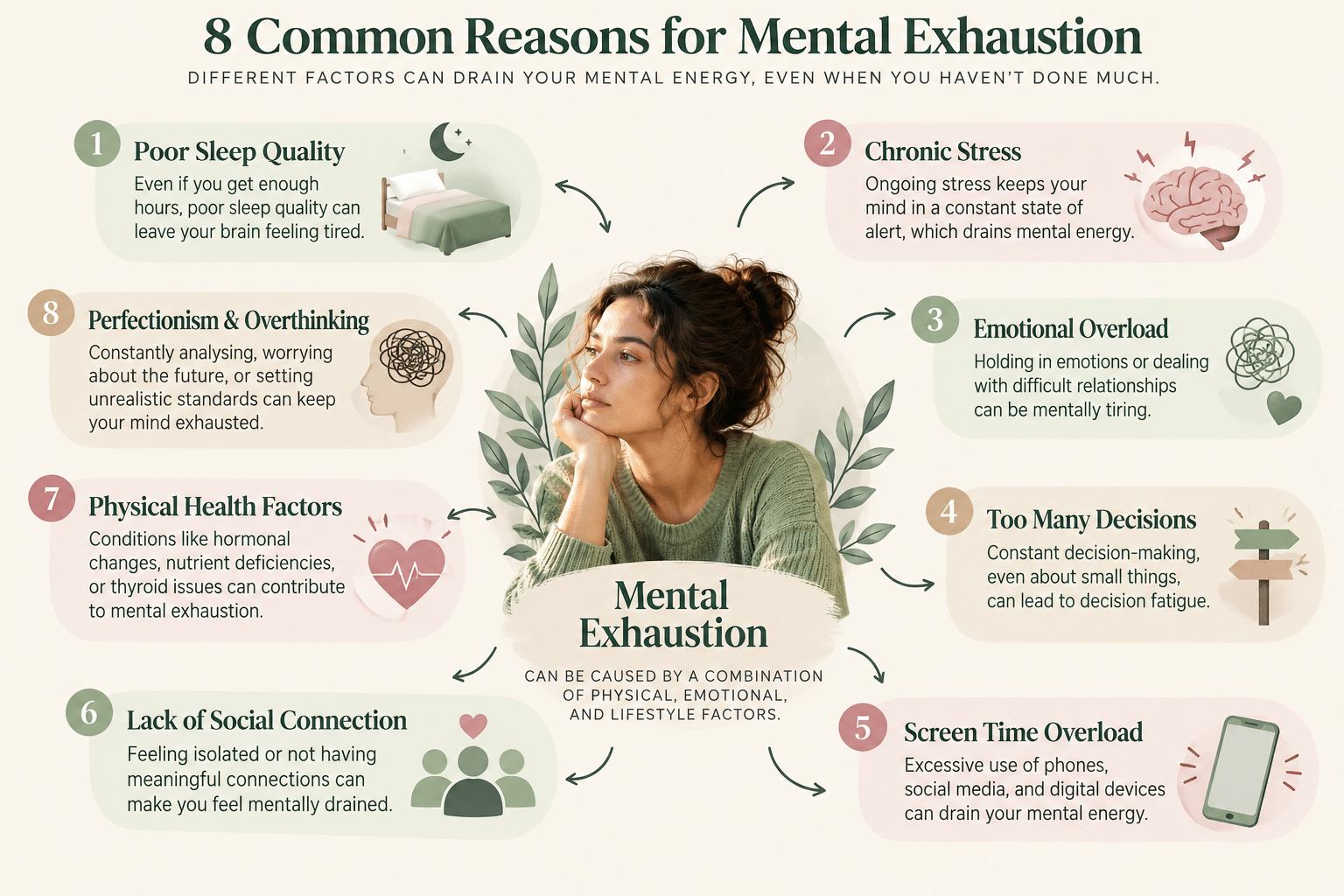
8 reasons you may feel mentally exhausted even on a quiet day
1. Your mind has been carrying unresolved stress
A day without meetings or errands can still be filled with mental activity: anticipating a difficult conversation, worrying about money, replaying an argument, or monitoring a problem you cannot immediately solve. The American Psychological Association explains that chronic stress can be associated with fatigue, irritability, and difficulty concentrating. Stress can be present even when it is not visible on a to-do list.
Try noticing: Do you feel tired after hours of thinking about something, even though you have taken little physical action? If thoughts keep circling without resolution, Rihzen’s Guided Journal Prompts for Overthinking can help you put them into words.
2. Your sleep is not as restorative as it seems
Time in bed is not always the same as restful sleep. Irregular sleep timing, frequent awakenings, and insufficient sleep can affect how alert you feel the next day. The CDC recommends at least seven hours of sleep for adults, although individual needs vary.
A quiet afternoon cannot necessarily make up for repeated nights of poor sleep. If you regularly wake unrefreshed, or someone notices loud snoring or gasping during sleep, discuss it with a healthcare professional rather than assuming it is only stress. The NHS lists sleep apnea among possible causes of ongoing tiredness.
3. You are constantly switching your attention
Replying to notifications, scrolling, checking email, and changing between unfinished tasks may make a day feel fragmented. This is a practical explanation for why a day with few completed tasks can still feel mentally busy; it is not proof that screen time alone caused your exhaustion.
Try noticing: How often do you interrupt a task to check something else? A short period of uninterrupted work followed by a genuine break may help you see whether fragmented attention is contributing.
4. Emotional responsibilities are taking up space
Supporting a loved one, managing tension at home, or trying to keep everyone comfortable can demand attention even when no obvious task is involved. You might be monitoring someone else’s mood, anticipating conflict, or suppressing your own feelings. These experiences can be draining, but they do not automatically indicate a mental health condition.
Ask yourself whether you have room to express what you need, or whether most of your energy is going toward responding to other people’s needs.
5. You are trying to make too many decisions
Small choices accumulate: what to prioritize, whether to reply, what to cook, how to spend money, what can wait. People sometimes call the subjective feeling of being worn down by choices “decision fatigue.” The term is useful conversationally, but it should not be treated as a stand-alone clinical diagnosis or a universally proven explanation for every lapse in self-control.
Consider reducing low-stakes choices by preparing a short priority list or deciding on a routine in advance. If even ordinary choices feel unusually difficult, explore why small decisions can feel overwhelming.
6. Your day contains little genuine recovery
Not working is not always the same as recovering. If a break is filled with worrying, obligations, or content that leaves you overstimulated, you may not feel restored. The NIMH recommends regular meals, sleep, manageable goals, social connection, and enjoyable low-stress activities as components of self-care.
Recovery can look different for different people. A walk may help one person; a quiet conversation, a short rest, or less stimulation may suit another.
7. Your mood may be affecting your energy
Stress, anxiety, and depression can be accompanied by fatigue, sleep changes, concentration problems, or loss of interest. Those symptoms have many possible causes, so feeling exhausted does not mean you have any particular condition. The NIMH advises considering how long symptoms have lasted and how much they interfere with daily life.
If low mood, worry, or lack of enjoyment is persistent or worsening, it is worth discussing with a qualified professional rather than trying to solve everything through productivity techniques.
8. There may be a physical or medication-related cause
Persistent tiredness is not always psychological. Possible contributors include iron-deficiency anemia, thyroid conditions, diabetes, sleep disorders, some infections, and medication effects. The NHS provides examples of these causes and recommends medical evaluation when fatigue persists, affects daily life, or comes with other symptoms.
Do not self-diagnose. A clinician can review symptoms, sleep, medicines, and medical history, and decide whether any testing is appropriate.
Mental exhaustion vs. stress vs. burnout: what is the difference?
These words overlap in everyday conversation, but they are not interchangeable.
| Term | What it generally describes | Important caveat |
|---|---|---|
| Mental exhaustion | A subjective feeling of reduced mental energy, attention, or emotional capacity. | A symptom description, not a specific diagnosis. |
| Stress | A response to perceived demands or pressures, sometimes short-term and sometimes ongoing. | Chronic stress can affect both mental and physical health. |
| Burnout | Exhaustion, cynicism or mental distance from work, and reduced professional efficacy in the context of chronic workplace stress. | The WHO defines burnout as an occupational phenomenon, not a medical condition or a label for all life exhaustion. |
| Persistent fatigue | Ongoing tiredness that may involve physical, cognitive, or emotional symptoms. | Medical and psychological causes may need assessment. |
The World Health Organization explicitly limits its burnout definition to the occupational context. If you feel depleted mainly by family, relationships, or general life pressures, “exhausted” or “overwhelmed” may be more accurate than assigning yourself a burnout label.
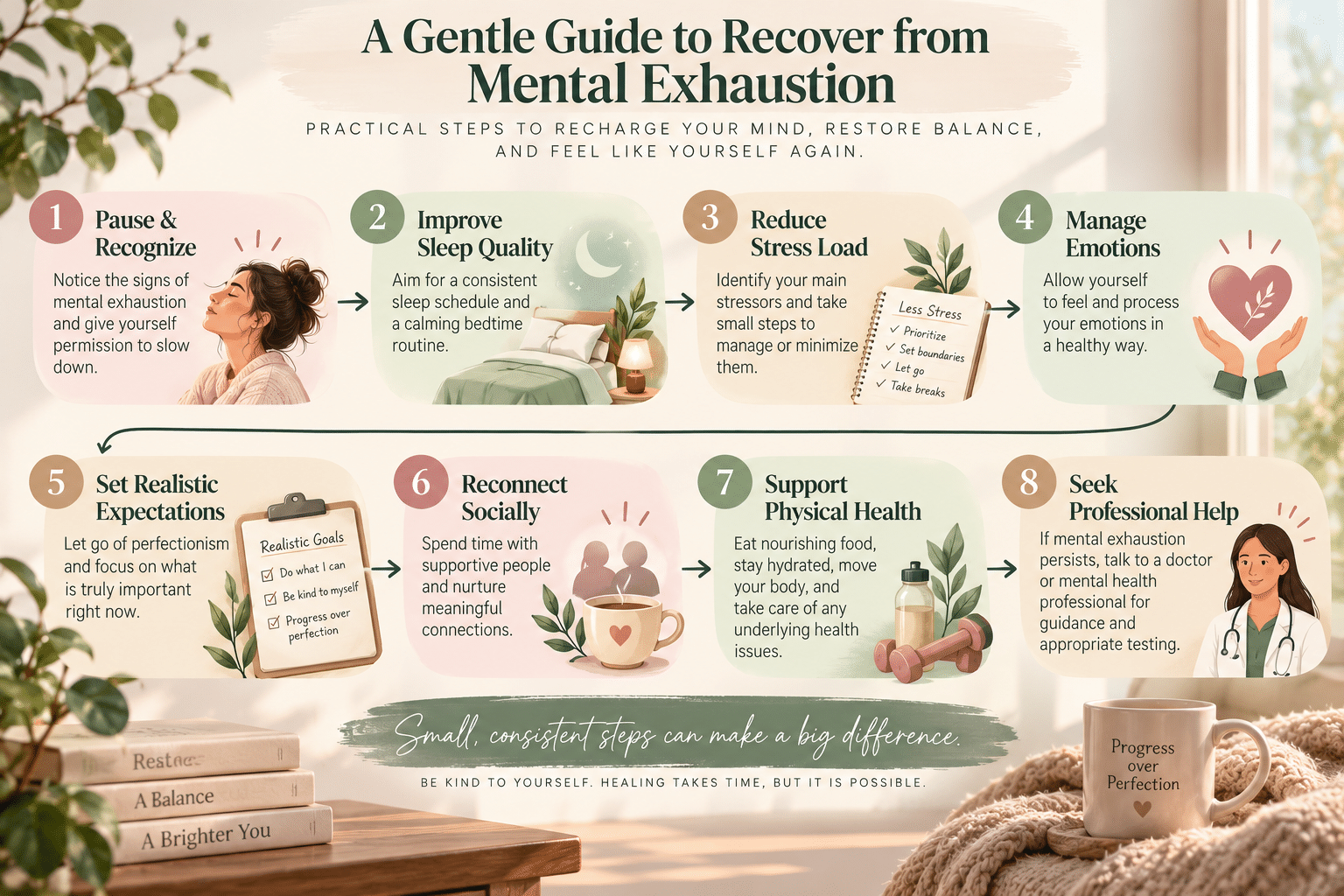
What to do when your mind feels exhausted
There is no single reset that fixes every cause. The most useful approach is to lower immediate demands, notice patterns, and address any underlying issue.
Start with a gentle 10-minute reset
This is an original Rihzen reflection exercise, not a validated medical treatment or diagnostic test.
- Minute 1–2 — Stop adding inputs. Put your phone aside, silence notifications if practical, and sit somewhere comfortable.
- Minute 3–4 — Name the load. Write down the one or two things taking up the most mental space. They may be emotions, unfinished tasks, or uncertainties.
- Minute 5–6 — Separate control from concern. Mark what you can act on today and what you cannot resolve right now.
- Minute 7–8 — Choose one manageable action. It might be sending a message, eating, drinking water, or moving one task to tomorrow.
- Minute 9–10 — Choose a recovery activity. Try quiet breathing, stretching, a short walk, or a calm break that genuinely suits you.
The goal is not to become productive in ten minutes. It is to create a little clarity and reduce avoidable pressure.
Protect the basics without turning self-care into another job
- Sleep: Aim for a consistent schedule and enough sleep for your needs; adults generally need at least seven hours. CDC guidance.
- Food and hydration: Eat regular, balanced meals and stay hydrated, as recommended by the NIMH.
- Movement: If appropriate for your health, try gentle activity rather than forcing an intense workout. The NHS notes that regular activity may improve energy over time.
- Boundaries: Decide which demands can wait and where you can ask for support.
- Connection: Talk with someone you trust if carrying things alone is making the day harder.
Track patterns, not just productivity
For a week, note your sleep quality, mood, energy, stressors, and any physical symptoms. Look for patterns without judging yourself. You can use Rihzen’s Mood Tracker to reflect on emotional patterns or the Stress Level Checker for educational self-reflection. Neither tool can diagnose a condition.
If your tiredness is closely tied to self-criticism or feeling behind, you may also find Why Do I Feel Stuck in Life? useful for exploring the difference between being overwhelmed and being directionless. If starting a goal feels exciting but sustaining it feels difficult, read Why Do I Lose Motivation After Starting Something? for ways to distinguish fading excitement from depleted energy.
When should you seek professional help?
Consider contacting a healthcare professional if exhaustion lasts for several weeks without a clear reason, interferes with everyday activities, or appears alongside symptoms such as unexplained weight changes, shortness of breath, palpitations, or disrupted breathing during sleep. These are examples highlighted in NHS fatigue guidance.
If distressing mental-health symptoms are severe or continue for two weeks or more—including persistent low mood, loss of interest, major sleep changes, or difficulty completing usual tasks—the NIMH recommends professional help. You can also seek help sooner whenever symptoms worry you.
Immediate safety: If you are in immediate danger, contact emergency services. In the United States, if you are experiencing suicidal thoughts or emotional crisis, call or text 988 for crisis support.
Frequently asked questions
Why am I mentally exhausted when I have done nothing all day?
Visible activity is only one kind of effort. Ongoing stress, rumination, disrupted sleep, emotional responsibilities, and health factors may contribute to exhaustion even on a quiet day. If it keeps happening, look for patterns and consider professional evaluation.
Can overthinking make you feel physically tired?
Prolonged worry and stress can coexist with fatigue and physical symptoms. However, feeling physically tired does not prove that overthinking is the cause; sleep problems, medicines, and medical conditions can also contribute.
Is mental exhaustion the same as depression?
No. Mental exhaustion is a description of how you feel, while depression is a health condition assessed using a broader pattern of symptoms. Persistent low mood, loss of interest, and changes in sleep or functioning deserve professional attention.
Can you be burned out without having a job?
People without jobs can absolutely feel exhausted or overwhelmed. However, the WHO’s formal definition of burnout specifically refers to chronic workplace stress, so it should not be used as a diagnosis for every kind of life exhaustion.
How long does mental exhaustion take to go away?
There is no reliable universal timeline. Recovery depends on the causes, how long symptoms have lasted, and whether sleep, stress, health conditions, or other issues are addressed. Persistent or worsening fatigue warrants professional advice.
Should I rest or try to be more productive?
If you are depleted, begin by assessing basic needs and reducing unnecessary demands. A small manageable task may help some people regain clarity, but forcing productivity is not a substitute for rest or treatment when needed.
What if I sleep enough but still wake up exhausted?
Sleep quality and health conditions matter as well as hours slept. If unrefreshing sleep is frequent—especially with loud snoring, gasping, or daytime impairment—speak with a healthcare professional.
When is tiredness a reason to see a doctor?
Seek medical advice when fatigue persists for weeks, interferes with your daily life, is unexplained, or comes with other concerning symptoms. You do not need to wait for symptoms to become severe before asking for help.
One final thought
Being mentally tired is not a measure of your character. Instead of asking why you did not accomplish more, try asking what your mind has been managing and what support or recovery it needs. If exhaustion persists, let that question lead to appropriate care—not self-blame.
References and further reading
- American Psychological Association. APA Dictionary of Psychology: Cognitive fatigue.
- American Psychological Association. How stress affects your health.
- Centers for Disease Control and Prevention. FastStats: Sleep in Adults.
- National Institute of Mental Health. Caring for Your Mental Health.
- National Institute of Mental Health. My Mental Health: Do I Need Help?.
- National Health Service. Tiredness and fatigue.
- National Health Service. Self-help tips to fight tiredness.
- World Health Organization. Burn-out an occupational phenomenon.
Editorial note: This article provides general educational information, not medical advice, diagnosis, or treatment. Rihzen’s reflection exercises are educational and have not been clinically validated. If you have ongoing or concerning symptoms, consult a qualified healthcare professional.


