

Why Do Small Decisions Feel Overwhelming When I’m Mentally Tired?
Why do small decisions feel overwhelming when I’m mentally tired? Because choosing between options takes attention, working memory, and some tolerance for uncertainty. When you’re tired, stressed, or already juggling demands, even deciding what to eat or which message to answer can feel disproportionately hard. You may not need more willpower. You may need less pressure, fewer choices, and a chance to recover.
Quick answer: Mental fatigue can make everyday decisions feel harder by reducing concentration and making trade-offs feel more demanding. Sleep loss, constant interruptions, worry about making the wrong choice, and too many competing priorities may contribute. Try narrowing your options to two, making low-stakes choices reversible, and postponing important decisions until you are more rested. This article offers reflection tools, not a diagnosis.
You might spend half an hour comparing two nearly identical products, reread a simple text before responding, or put off picking dinner because every option feels like effort. Then comes another exhausting question: Why can’t I just decide?
That second layer of self-criticism often makes an ordinary moment harder. Below, we’ll explore what research does—and does not—say about mental fatigue and decision-making, how to recognize different patterns, and how to make your next choice more manageable.
What Does It Mean When Small Decisions Feel Overwhelming?
It can mean your mind is having trouble sorting information, weighing options, or committing to a choice when your mental resources feel stretched. You might still be capable of making the decision; it simply requires more effort than usual.
People often call this decision fatigue, but that term is not a medical diagnosis. Researchers also use the term differently across settings. A 2025 systematic review of clinical decision fatigue highlighted variation in definitions and measurements, so we should avoid treating it as one fully settled mechanism that explains every experience of indecision [1].
More broadly, cognitive fatigue is a complex state related to difficulty sustaining demanding mental performance. A 2024 systematic review describes challenges in measuring it reliably, which is another reason not to diagnose yourself from a difficult afternoon [2].
The useful question is less “What label do I have?” and more “What makes this particular choice harder today?”

Seven Reasons Small Decisions Feel Hard When You’re Mentally Tired
1. Your attention has already been stretched
Imagine a day filled with meetings, messages, caregiving, and dozens of interruptions. By evening, another decision can feel like one more item added to an invisible workload. Sustained mental effort may make it harder to maintain concentration, even if the final choice is objectively simple.
The CDC notes that fatigue can reduce attention and short-term memory and impair judgment in work settings [3]. That finding does not prove every dinner dilemma is caused by fatigue, but it supports taking tiredness seriously as a factor in mental performance.
If your brain feels overloaded even when you’re not physically active, read Rihzen’s guide to feeling mentally exhausted.
2. You are trying to prevent every possible mistake
The decision may be small, but the rule you’re applying to it may be enormous: I must choose the best option. Picking a restaurant becomes a test of whether the evening will be enjoyable. Replying to a friend becomes a fear of being misunderstood. Buying a notebook becomes a search for the perfect notebook.
When every choice is treated as final, important, or revealing something about your character, the amount of checking can grow. This is a possible pattern to reflect on, not proof of a specific disorder.
3. Too many options compete for your attention
Some choices require more comparison than others. Ten possible meals, countless online reviews, and conflicting recommendations can make it difficult to notice which difference actually matters.
However, the popular claim that more options always reduce decision quality is too simple. The real burden depends on context, preferences, option complexity, and stakes. A practical experiment is to reduce your shortlist and see whether the decision becomes easier.
4. Your body has not had enough recovery
Sleep, food, hydration, and breaks are not substitutes for solving every problem, but they influence how ready you feel to think through one. If you have been sleeping poorly or working without pauses, consider recovery before tackling a consequential decision.
The CDC identifies sleep loss and prolonged mental or physical exertion as contributors to fatigue, with potential effects on attention and decision-making [4].
5. Small decisions are standing in for bigger concerns
Sometimes you are not just choosing between two plans. You may be wondering whether people will be disappointed, whether you can afford a mistake, or whether saying no will cause conflict. The practical question has an emotional background.
For example, “Should I go out tonight?” can quietly include “Will my friend think I don’t care?” If you often worry about people’s reactions to your choices, Rihzen’s article about feeling guilty when saying no may offer a useful perspective.
6. You have too many unfinished decisions
An overflowing to-do list can leave you repeatedly switching between priorities. Choosing which task to do first may become harder when every item appears urgent. You don’t always need a better answer; sometimes you need fewer active questions.
If you’re doing plenty yet seeing little progress, explore why you may feel unproductive even when busy.
7. Stress or mood changes are affecting concentration
Ongoing anxiety, low mood, and major stress can affect attention and everyday functioning. They are not the only explanations, and a rough week does not automatically mean you have a mental health condition.
Still, the National Institute of Mental Health lists difficulty concentrating or making simple decisions among possible symptoms to discuss with a professional when symptoms are severe or persistent [5].
Decision Fatigue, Anxiety, and Burnout: What’s the Difference?
These experiences can overlap, but they are not interchangeable. Noticing what accompanies your indecision can be more useful than assuming one explanation.
| Possible pattern | What you might notice | Question to ask |
|---|---|---|
| Mental fatigue | Choices are harder after demanding work or poor rest | Does it ease after genuine recovery? |
| Anxiety or fear of mistakes | You replay consequences and seek repeated reassurance | Am I afraid of what this choice means? |
| Overload | Several responsibilities all feel equally urgent | Can anything be removed or deferred? |
| Possible burnout-related strain | Work-related exhaustion, distance from work, or reduced effectiveness | Is the difficulty tied to chronic workplace stress? |
| Persistent mood or health concerns | Decision difficulty accompanies broader lasting symptoms | Would a health professional’s assessment help? |
Burnout, as described in international occupational guidance, concerns chronic workplace stress; it should not become a casual label for every tiring day. Similarly, decision difficulty alone cannot identify depression, anxiety, ADHD, or another condition.
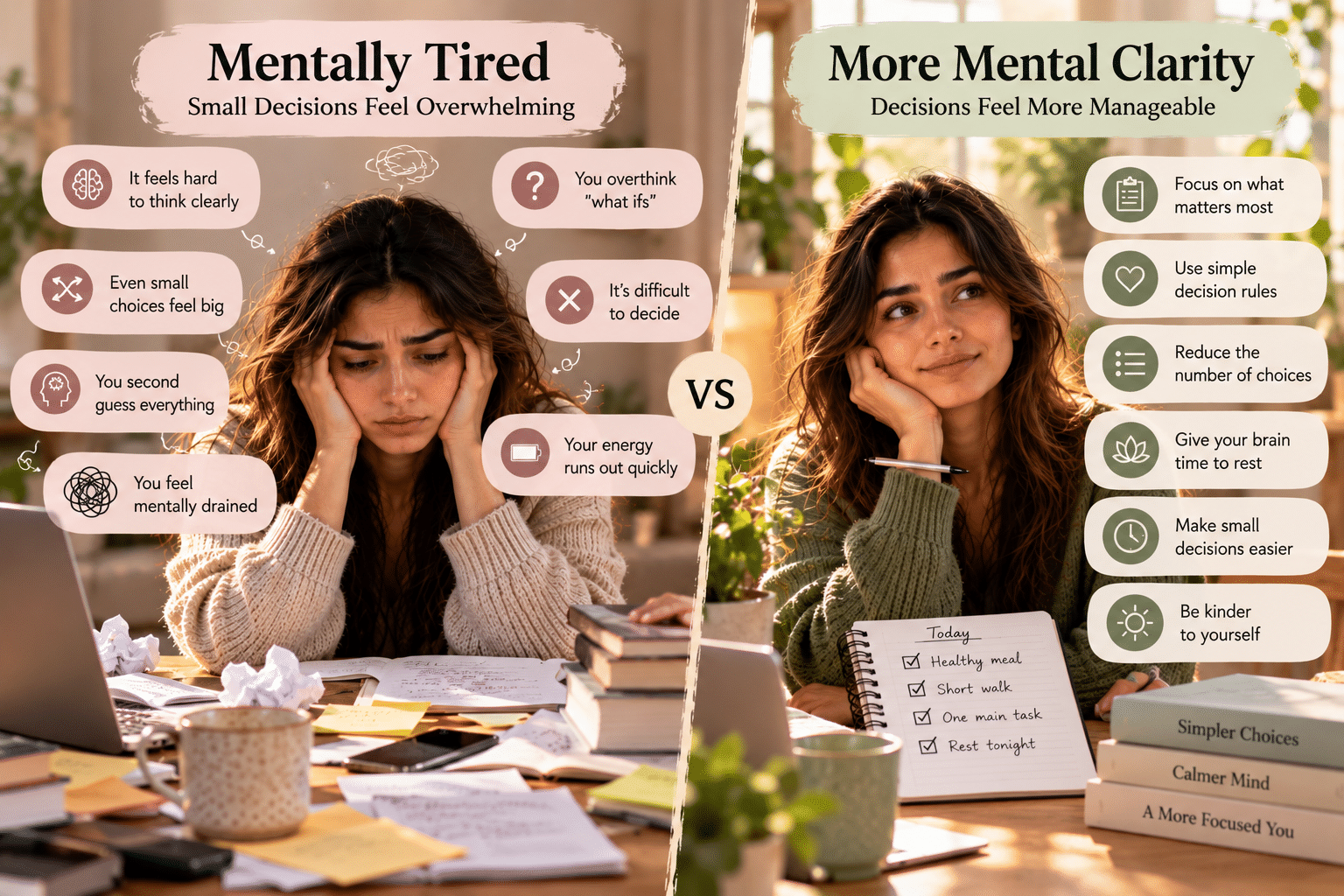
Eight Practical Ways to Make Small Decisions Easier
1. Sort choices by consequences
Ask whether the choice is low stakes and reversible, important but reversible, or high stakes and hard to reverse. Choosing lunch usually needs much less analysis than signing a major contract. Save your careful thinking for decisions that deserve it.
2. Choose two acceptable options—not the perfect option
Shortlist two possibilities that meet your basic requirements. If both are acceptable and the consequences are small, choose one. You are practicing sufficiency, not careless decision-making.
3. Put a boundary around comparison time
For a low-stakes choice, decide how long you want to compare: perhaps two or five minutes. Time limits should be flexible and not used for choices involving health, safety, legal consequences, or substantial money.
4. Make one default for repeat decisions
Defaults are useful for frequent, minor decisions: two weekday breakfast choices, a standard grocery list, or a regular time for checking messages. A default isn’t a rule you can never break. It simply removes unnecessary repetition.
5. Write down the one factor that matters most
Instead of comparing everything, identify your main criterion. “I need the least expensive acceptable option.” “I need something that works with my schedule.” “I want a calm evening.” This helps you separate your needs from irrelevant details.
6. Use an if–then plan for recurring situations
For a choice that regularly stalls you, make a specific advance plan: If I have not chosen lunch by noon, then I will select one of my two usual options. Research on implementation intentions suggests that specifying a situation and response can support goal-directed action, although it is not a guaranteed cure for indecision [6].
7. Delay a major choice—not every choice
If you’re exhausted, postpone a nonurgent high-stakes decision until you’ve rested or consulted an appropriate person. But avoid turning postponement into a pattern that makes every ordinary task linger indefinitely. Distinguish recovery from avoidance.
8. Address the strain underneath the decision
If you are repeatedly overwhelmed, simplifying one choice might help today, but it may not address chronic workload, poor sleep, relationship stress, or emotional distress. Consider which underlying pressure is worth changing. You can use Rihzen’s Stress Level Checker for non-diagnostic reflection, or its Wheel of Life Assessment to review where your time and attention are going.
A useful rule: Low-stakes choices need a reasonable answer. High-stakes choices deserve appropriate care. Neither requires you to prove your worth through perfect decisions.
A Two-Minute Exercise for When You Can’t Decide
Try this the next time a minor decision has you stuck:
- Name the choice. “I need to choose what to cook tonight.”
- Check the stakes. “This is low stakes and reversible.”
- Set one criterion. “It needs to be quick and use ingredients I have.”
- Reduce options to two. “Pasta or eggs and toast.”
- Choose and close the loop. “Pasta works. I don’t need to reopen the question.”
Notice your reaction afterward. Did the pressure drop? Did anxiety remain even after the choice was made? Did you realize you were simply too tired to cook? Each response offers different information about what you actually need.
For decisions that trigger repetitive self-criticism, Rihzen’s Guided Journal Prompts for Overthinking can provide a more structured reflection space.

A Real-Life Example: When Picking Dinner Feels Impossible
What changes: Instead of asking what the best dinner would be, she asks what she needs tonight: food without much effort. She narrows the choice to leftovers or one familiar takeout option. For the invitation, she recognizes that she needs rest and responds kindly without crafting a perfect explanation.
The lesson: The problem wasn’t necessarily that Maya lacked decision-making ability. Several decisions were competing for attention when she was already tired. Reducing their scope made the evening more manageable.
This is an illustrative example, not a clinical case study. Sometimes choosing becomes easier after simplifying the environment; other times persistent difficulty deserves a closer look.
When Should You Seek Help for Difficulty Making Decisions?
Consider talking with a health professional if decision difficulty is new, persistent, worsening, or meaningfully interfering with work, relationships, self-care, or daily responsibilities. It is especially important to seek evaluation when it occurs alongside substantial sleep changes, low mood, severe anxiety, loss of interest, memory problems, or other concerning symptoms.
NIMH advises seeking professional support for severe or distressing symptoms lasting two weeks or more, including problems with concentration or completing normal activities [7]. You do not need to wait for a specific deadline if symptoms are severe or your safety is at risk.
If confusion or difficulty thinking starts suddenly, particularly with weakness, speech problems, severe headache, or other acute symptoms, seek urgent medical evaluation rather than treating it as ordinary decision fatigue.
Remember: This article is educational and cannot determine the cause of your symptoms or replace personalized medical advice.
Frequently Asked Questions
Why do small decisions feel overwhelming when I’m mentally tired?
Because ordinary choices require concentration and evaluation. When you are tired or stressed, weighing even two options may feel more demanding. Too many choices and fear of mistakes can add to the pressure.
Is decision fatigue a real condition?
Decision fatigue is a term used in research and everyday conversation, but it is not a standalone medical diagnosis. Studies use different definitions and measurements, so it should not be treated as an explanation for every experience of indecision.
Can lack of sleep make it harder to make choices?
Yes. Inadequate sleep can affect attention, memory, and judgment. If your decisions become harder after poor sleep, recovery may help, though persistent problems can have other causes.
Why do I overthink small decisions but handle big ones?
Some everyday choices arrive when your attention is depleted or involve hidden concerns such as social judgment. You may also have clearer criteria for important decisions than for dozens of minor ones.
How can I stop overthinking what to eat or wear?
Try a small rotation of acceptable defaults, limit comparison, and remind yourself that a low-stakes decision does not require a perfect result. Keep flexibility for changing needs.
Should I make decisions when I am exhausted?
For minor decisions, use a simple default. For major or irreversible decisions, take time to rest and seek appropriate information or advice when possible.
Can anxiety or depression make decisions harder?
They can be associated with concentration and decision difficulties, but those symptoms alone do not establish a diagnosis. Seek professional evaluation if problems are lasting, distressing, or disrupting daily life.
What’s the fastest way to make an everyday decision?
Define one important criterion, narrow the choices to two acceptable options, and select one if the decision is low stakes and reversible. More time is appropriate when the consequences are serious.
Research and References
- Clinical decision fatigue: a systematic and scoping review with meta-synthesis (2025). PubMed.
- Dickens, A., Champion, A. J., & Schenke, K. C. (2024). Fatigue management: a systematic review of objective measurement techniques for cognitive fatigue. PubMed.
- CDC/NIOSH (2026). Fatigue and Work.
- CDC/NIOSH (2020). Work-related Fatigue Reaches Beyond the Workplace.
- National Institute of Mental Health (2025). My Mental Health: Do I Need Help?.
- Gollwitzer, P. M., & Sheeran, P. (2006). Implementation intentions and goal achievement: A meta-analysis. University of Konstanz publication record.
- National Institute of Mental Health. Caring for Your Mental Health.


